
The Three Defaults: CI EI AI - Most leaders have one. Few know which one is running them.
The Three Defaults: CI EI AI - Most leaders have one. Few know which one is running them.
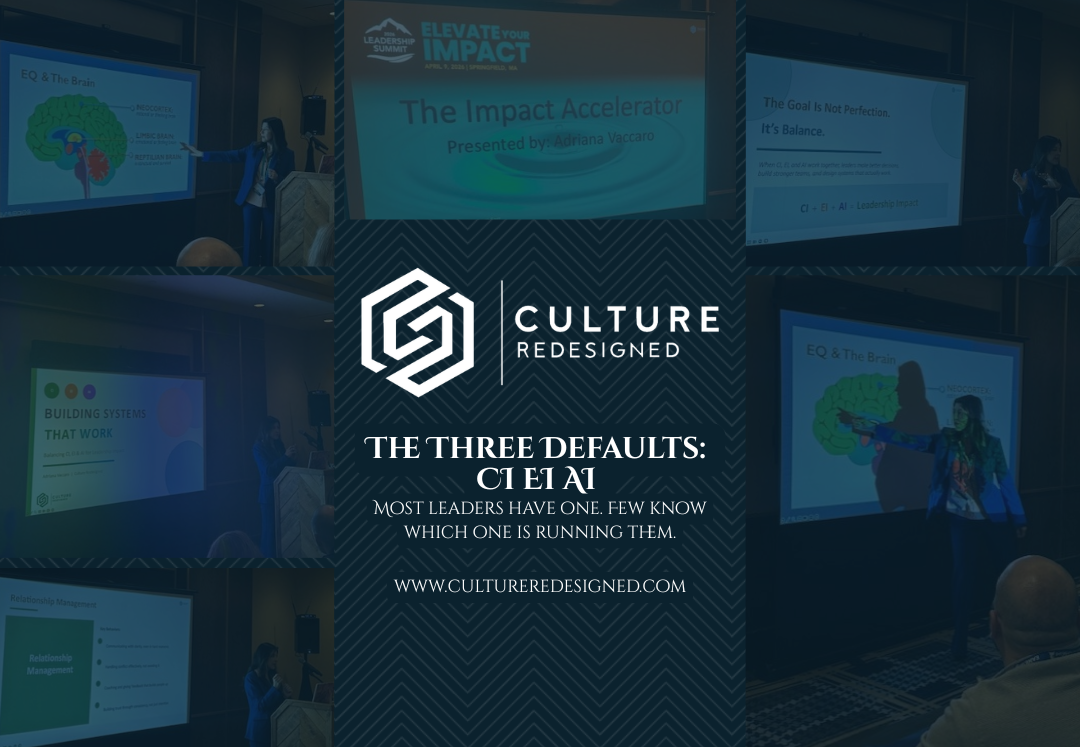
Earlier this month, Adriana Vaccaro took the stage at the 2026 Employers Association of the NorthEast Leadership Summit in Springfield, Massachusetts. The room was full of leaders at different stages of their careers, different industries, different challenges. But the question she opened with landed the same way for all of them.
When things got hard last time, where did you go first?
Some went to data. Some read the room. Some reached for a tool. Most had never stopped to ask themselves which one they were doing, or what it was costing them when that default ran unopposed.
That question is the foundation of the CI-EI-AI Leadership Framework, the model Adriana brought to the Summit. Built around three forces that shape every consequential leadership decision: Critical Thinking, Emotional Intelligence, and Artificial Intelligence. Not as concepts to admire. As disciplines that have to work together, or they quietly work against each other.
Critical Thinking is the systems lens. It is what allows a leader to look at a recurring problem and ask not who caused it, but what structure keeps producing it. Most people problems are actually system problems. The employee struggling with follow-through is often operating inside a system with unclear expectations, no feedback loop, and no defined ownership. Critical thinking does not assign blame. It asks what would have to change for this to stop happening.
Emotional Intelligence is what keeps critical thinking from becoming cold. It is not softness and it is not conflict avoidance. EI is what allows a leader to deliver difficult feedback in a way the other person can actually hear. It is the ability to manage your own reaction before it manages your team, read unspoken tension in a room, and build trust through consistency rather than just intention. Leaders with high EI do not skip accountability. They make it land.
Artificial Intelligence is the accelerant. It can draft a coaching conversation, surface patterns in team data, stress-test a decision, and help a leader prepare for the hardest meeting of their week. What it cannot do is read the relationship, supply the context, or replace the judgment that only comes from knowing the people and the history. AI is only as useful as the thinking and emotional clarity behind the prompt.
The danger is not weakness in any one area. It is the leader who defaults to one and mistakes it for a complete approach. Too much critical thinking without EI produces decisions that are logically sound and humanly tone-deaf. Too much EI without systems thinking creates warmth without accountability. Too much AI without judgment creates speed without wisdom, and that combination tends to produce mistakes that are both costly and visible.
Your default, left unexamined, is what is running your decisions more than any strategy or intention ever will. Understanding all three forces, and knowing when to lead with each one, is not a personality trait. It is a practice.
Culture-Minded by Adriana Vaccaro builds the system behind that practice, grounding intentional leadership in behavioral science and real-world application.
Read Culture-Minded Here


.svg)
.avif)


.svg)


