
The Manager Collapse
The Manager Collapse
Every year Gallup publishes its State of the Global Workplace report and every year the headline is some version of the same story: employee engagement is declining. This year the number is 20%, the lowest it has been since 2020, and the first time in Gallup's history that engagement has dropped for two consecutive years.
That number is worth paying attention to. But it is not the most important number in the report.
The number that matters is this: manager engagement has dropped nine points since 2022. In just the last year alone it fell five points, from 27% to 22%. Individual contributor engagement, by comparison, has remained largely flat.
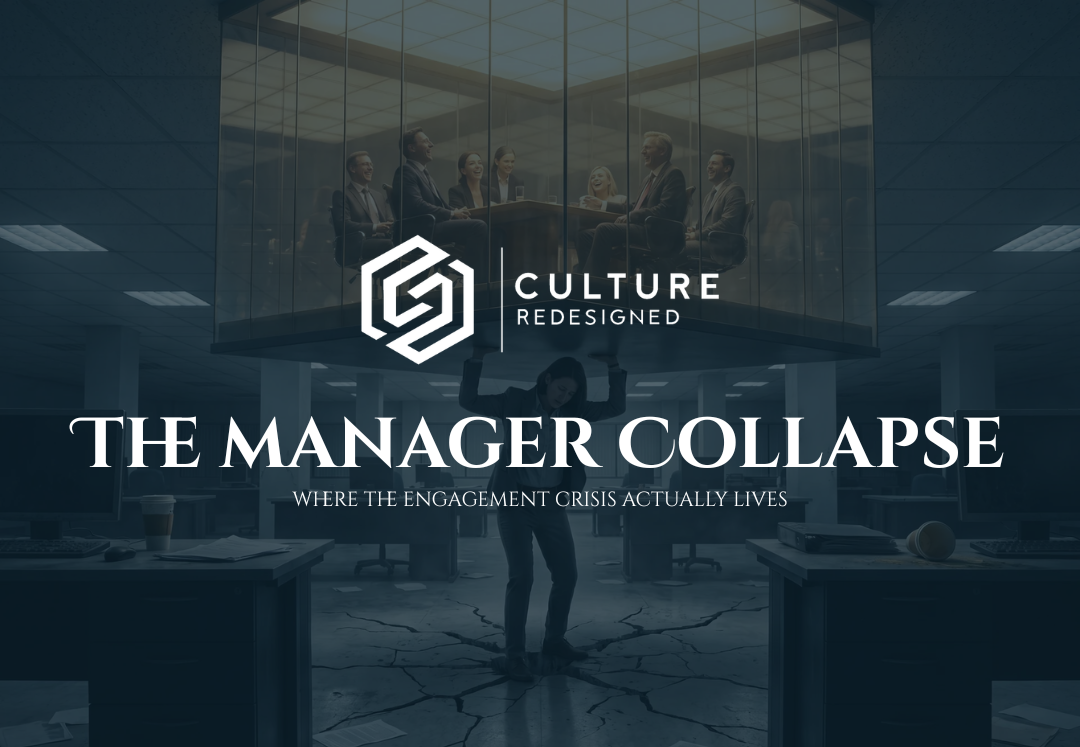
This is not a workforce-wide disengagement problem. It is a manager-specific collapse. And it is happening in the exact layer of the organization that determines whether culture lives or dies on any given Tuesday.
Most organizations understand, at least in theory, that managers shape culture more than any policy, value statement, or executive communication ever will. The person someone reports to directly determines how feedback lands, how accountability gets practiced, how psychological safety either exists or doesn't in day-to-day work. Managers are not just a layer of the org chart. They are the daily experience of your culture for the majority of your workforce.
So when manager engagement falls nine points in three years, what is actually happening is that the daily experience of culture for most employees is being delivered by people who are themselves checked out, burned out, or both.
The Gallup data points to why. Managers have absorbed an extraordinary amount of organizational change over the past several years, AI adoption, restructuring, return-to-office mandates, workforce reductions, and accelerating performance expectations, without receiving meaningfully more support, development, or clarity about what their role is actually supposed to look like now. They are being asked to lead through more complexity with fewer resources and less psychological bandwidth than at any point in recent memory.
The response from most organizations has been another wellbeing program. Another engagement survey. Another all-hands about resilience. None of which addresses the structural reality that the manager role itself has been quietly broken by the pace of change around it.
What the data also shows is what is possible on the other end. In best-practice organizations, 79% of managers are engaged. That is nearly four times the global average. The gap between those organizations and everyone else is not talent. It is design. It is whether the organization has intentionally built the conditions, the development, the clarity, the support structures, that allow managers to lead well rather than simply survive.
That gap is a culture problem before it is a manager problem. And culture problems do not get solved by treating the symptom.
If your organization is seeing performance strain, disengagement, or turnover you cannot fully explain, the answer may not be in your employee data. It may be in the layer just above it, the managers who are quietly carrying more than the organization has ever acknowledged, and getting less in return than the role now demands.
Gallup gave us the diagnosis. The question is whether leadership is willing to look at the actual cause.
Culture-Minded by Adriana Vaccaro builds the framework for doing exactly that, starting with the systems and structures that either support or silently undermine the people responsible for carrying your culture every day.
Read Culture-Minded Here
For managers and emerging leaders ready to close that gap themselves, the Impact Accelerator was built for exactly this moment.
Learn More Here


.svg)
.avif)


.svg)


