
The Hidden Cost of Training Scrap Rate
The Hidden Cost of Training Scrap Rate
The term scrap rate comes from manufacturing. It describes the portion of material, time, or effort that ends up unusable. Something was produced, but it couldn’t be used as intended, so it was discarded.
Years ago, someone asked me how that idea shows up in organizations that don’t make physical products. The answer was immediate.
It shows up in training.
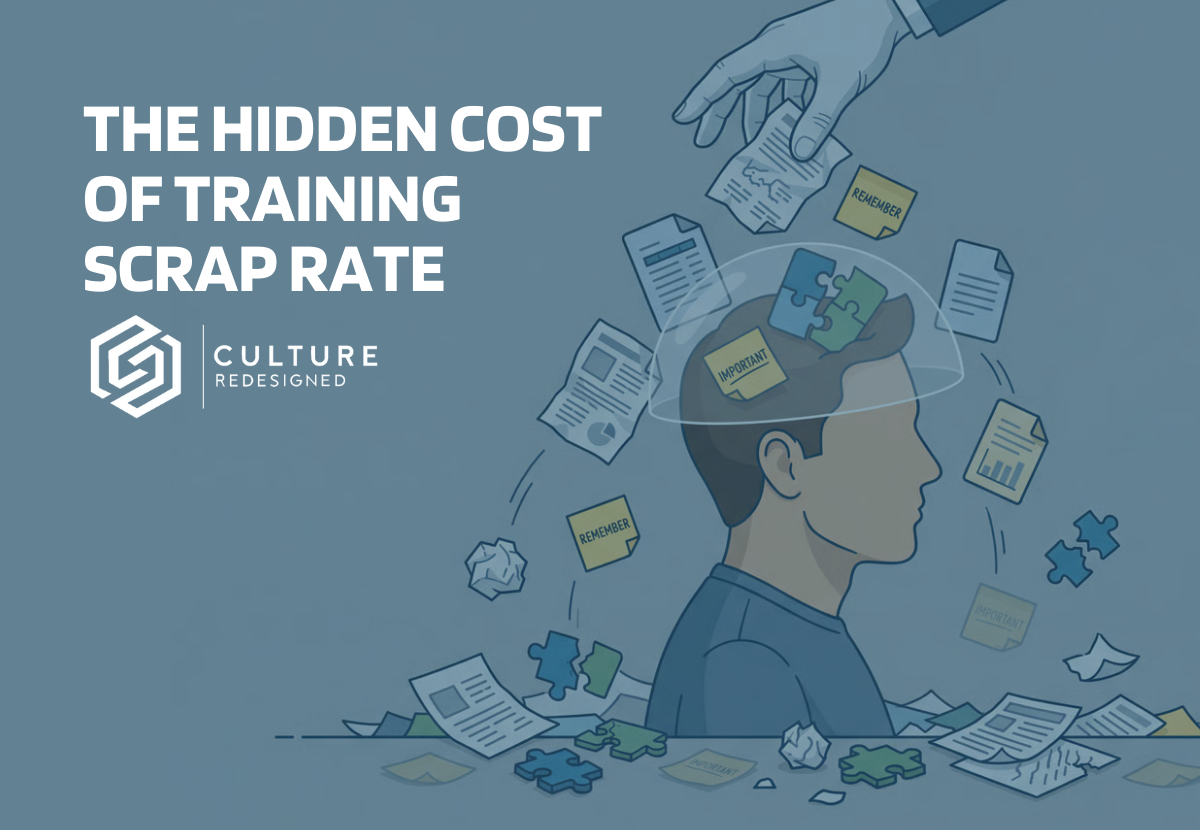
Most organizations don’t struggle because they fail to invest in learning. They struggle because much of that investment never makes it into day-to-day behavior. People attend sessions. Content is delivered. Notes are taken. And then the work resumes, largely unchanged.
That gap is training scrap rate.
In leadership development and culture work, scrap rate doesn’t announce itself. It shows up quietly. Leaders revert to old habits under pressure. Teams adopt the language of training without changing how decisions get made. Frameworks get referenced, but not applied. Over time, learning becomes something people remember having done, not something they actively use.
What’s often misunderstood is where scrap rate actually comes from.
It rarely comes from poor content. Some of the most thoughtful, research-backed training fails to stick. The issue is usually the environment learning returns to.
If the pace of work doesn’t allow for reflection, learning fades. If managers aren’t supported to model or reinforce new behaviors, learning stalls. If people feel punished for slowing down, asking questions, or trying something new, learning gets shelved in favor of survival.
In those conditions, behavior adapts quickly to what the environment rewards.
This is why scrap rate is such a useful signal. It reveals the gap between what an organization says it values and how work actually operates, without needing another survey. High scrap rate points to misalignment. Low scrap rate suggests learning is supported, reinforced, and given room to show up in real decisions and conversations.
Organizations that reduce scrap rate tend to do a few things consistently.
They design learning with application in mind, not just delivery. They create space to practice and reflect, not just absorb information. They equip managers to carry learning forward instead of treating training as a standalone event. And they pay close attention to what happens after training ends, when real pressure returns.
None of this requires more training. In many cases, it requires less.
Less content. Less urgency. More intention.This is often where scrap rate begins to drop.
Shorter, highly focused learning experiences tend to stick more easily, especially for leaders carrying full schedules. When the scope is clear and the application is immediate, learning has a better chance of showing up in real work instead of getting lost once the session ends.
That’s the intention behind our February 27 Accelerated Organizational Culture Consultant program. It’s a one-day, in-person experience designed to create usable insight and tools right away. Not a replacement for longer-term development, but a focused entry point for people who want to apply culture work immediately and build from there.
Reducing scrap rate means treating learning as part of a system, not an interruption to it.
It means recognizing that culture plays a quiet but decisive role in whether new skills are used or quietly abandoned. When learning sticks, it’s rarely because people were more motivated. It’s because the conditions made it possible.
Once leaders see scrap rate clearly, it becomes difficult to overlook.


.svg)
.avif)


.svg)


